Try searching for a destination, airline, or route
Rail travel in Japan.
The Shinkansen runs faster and more often than anything in its class. Whether the JR Pass is worth buying is a different question. Here is both.
JR network
~30,000 km
Shinkansen
3,000 km
Top speed
320 km/h
Operators
6 JR companies
Japan's railways - the Shinkansen and everything else.
Japan's rail network is built around the Shinkansen backbone - ten dedicated high-speed lines covering roughly 3,000 km - operated by five regional JR companies. JR East handles Tokyo and the north-east. JR Central runs the Tokaido Shinkansen between Tokyo and Osaka, the busiest high-speed corridor in the world.
JR West extends that corridor south through Hiroshima to Hakata. JR Kyushu runs the island's own network. JR Hokkaido connects Honshu to Sapporo via the Seikan Tunnel under the Tsugaru Strait.
Below the Shinkansen sit the conventional JR lines - Limited Express, Rapid, Local - plus a dense web of private railways. In Tokyo alone, Tokyo Metro, Toei Subway, and a dozen private operators run commuter lines that the JR network barely touches. Osaka and Kyoto have their own private-line ecosystems. An IC card handles all of it.
Suica and Pasmo cover nearly every rail, bus, and ferry service in Japan - Suica from JR East, Pasmo for Tokyo's private lines. They are interchangeable at most gates. ICOCA does the same for the Kansai region. Load any of them onto an iPhone via Apple Wallet.
A working rule for choosing your service: Shinkansen if it gets you there in under three hours. Limited Express if the Shinkansen doesn't serve the route. IC card and local trains for everything within a city. The pricing is scaled to match, so the right choice is usually obvious once you know the hierarchy exists.
The JR Pass - and when not to buy it.
The JR Pass is a multi-day unlimited ticket covering most JR Group trains across Japan: Shinkansen (with the Nozomi and Mizuho exception), Limited Express, Rapid, and Local services. You choose a duration - 7, 14, or 21 consecutive calendar days - before you travel. Activate on a Monday and your 7-day pass expires the following Sunday at midnight, whether you rode trains every day or none.
Current prices: 7 days at ¥50,000, 14 days at ¥80,000, 21 days at ¥100,000 for Ordinary class. Green Car adds ¥20,000 to each tier. These prices have been unchanged since the October 2023 hike, which raised them by roughly 70% from the previous structure.
The pass is only available to temporary visitors - the standard 90-day tourist entry. You buy an exchange order before arriving and redeem it at a JR office in Japan. Do not activate it immediately.
If you're spending two or three days in Tokyo before leaving, exchange the voucher and set the activation date for your first long-distance departure. Three Tokyo days on a ¥50,000 pass is about ¥1,500 of Yamanote fares. Activate on departure.
To check whether the pass is worth it, open a note and price every long-distance leg you're planning as individual tickets. Add them up. If the total beats the pass price, skip the pass.
A 7-day pass at ¥50,000 needs roughly ¥7,000 of JR fares per day to break even. A Tokyo-Osaka return on Hikari costs around ¥28,000 - ¥22,000 short of the pass on its own. You need at least Hiroshima, Kanazawa, or Hakata on top before the maths work in the pass's favour.
For the rest, an IC card is almost always cheaper and more flexible. Load a Suica with ¥5,000-¥10,000, tap on and off, and top up when it runs low. It works in convenience stores and vending machines too. The pass doesn't.
For a full breakdown with worked examples, see the JR Pass guide.
JR PASS AND SHINKANSEN TICKETS
Klook
Buy your JR Pass exchange order or reserve individual Shinkansen tickets through Klook. Ships the exchange order before you travel. Often a small discount on the official rate.
JR EAST DIRECT (TOHOKU, HOKURIKU, JOETSU)
jreast.co.jp
Book Tohoku Shinkansen (Hayabusa to Sendai, Aomori, and Hokkaido) and Hokuriku Shinkansen (Kagayaki to Kanazawa) directly at jreast.co.jp. Accepts foreign credit cards.
The Japan Rail Pass used to be a no-brainer. The 2023 price hike changed that.
- Patrick Hughes, Planet Patrick editor
Ordinary, Green Car, and Gran Class - what each one gets you.
The same carriages run Nozomi, Hikari, and Kodama on the Tokaido Shinkansen. The class you sit in changes the seat, not the speed. Ordinary is 2+3 seating across the carriage, with a power outlet at each seat, decent legroom, and free WiFi. Green Car is 2+2, wider seats, footrests, and a noticeably quieter cabin.
Gran Class is available on select E5 and E7 series trains on the Tohoku and Hokuriku Shinkansen. It is closer to airline business class: a reclining seat-to-table position, a meal included, and an attendant on call. Green Car is worth the premium on legs of four hours or more. Gran Class is for the journey itself, not just the destination.
Seating Classes
Ordinaryfrom ¥13,870
2+3 seating. Power outlet at every seat. Free WiFi (one-time email registration). Adequate legroom for most passengers. The right call for any Shinkansen leg under four hours.
Best for: most journeys
Green Carfrom ¥19,590
2+2 seating, wider seats with footrests, quieter cabin. JR Pass holders pay a supplement to upgrade. Worth considering on back-to-back long-haul days or legs of four hours or more. On a one-hour hop, you won't notice the difference.
Best for: legs of 4+ hours
Gran Classsupplement from ~¥10,000, depending on route
Available on select E5 (Hayabusa) and E7 (Kagayaki) trains. Reclining seat-to-table position, meal and drinks included, dedicated attendant. One car per train, limited allocation. JR Pass holders pay the full Gran Class supplement. Book as early as possible.
Best for: special journeys
Practical intelligence
IC card
Suica (Tokyo) or ICOCA (Kansai) taps across almost every rail, bus, and ferry service in Japan, plus convenience stores and vending machines. Max balance ¥20,000. Load onto iPhone via Apple Wallet - no physical card needed. One IC card is enough for the whole trip.
Seat reservation
Free with the JR Pass; ¥320-730 per journey without it. Hayabusa and Komachi trains are fully reserved - no unreserved cars, no turn-up-and-ride. Hikari and Kodama have 1-3 unreserved cars. Reserve popular morning services during cherry blossom season and Golden Week well ahead.
Oversized luggage
Bags with a total dimension (length plus width plus height) over 160 cm require a free advance reservation for the designated luggage space at the end of the car. Board without one and pay ¥1,000. Bags over 250 cm total are not permitted on Shinkansen. Standard 28-inch suitcases typically come in under 160 cm.
WiFi
Shinkansen Free Wi-Fi runs on all major services. Requires a one-time email registration, then auto-connects on subsequent journeys. Drops in tunnels - notably between Odawara and Shizuoka on the Tokaido.
Food on board
Trolley service ended in October 2024. There is no onboard catering on the Tokaido Shinkansen. Buy an ekiben (station boxed meal) before boarding. Tokyo Station's Gransta market - on the concourse inside the gates - has the best selection. Allow 10 minutes before your departure.
Luggage forwarding
Takkyubin (Yamato Transport / Kuroneko) ships bags between hotels overnight from around ¥1,000-2,000 per bag. Drop at your hotel reception or a convenience store by 10-11 PM; the bag arrives at your destination the next afternoon. Essential for multi-city trips with heavy luggage.
Rolling stock
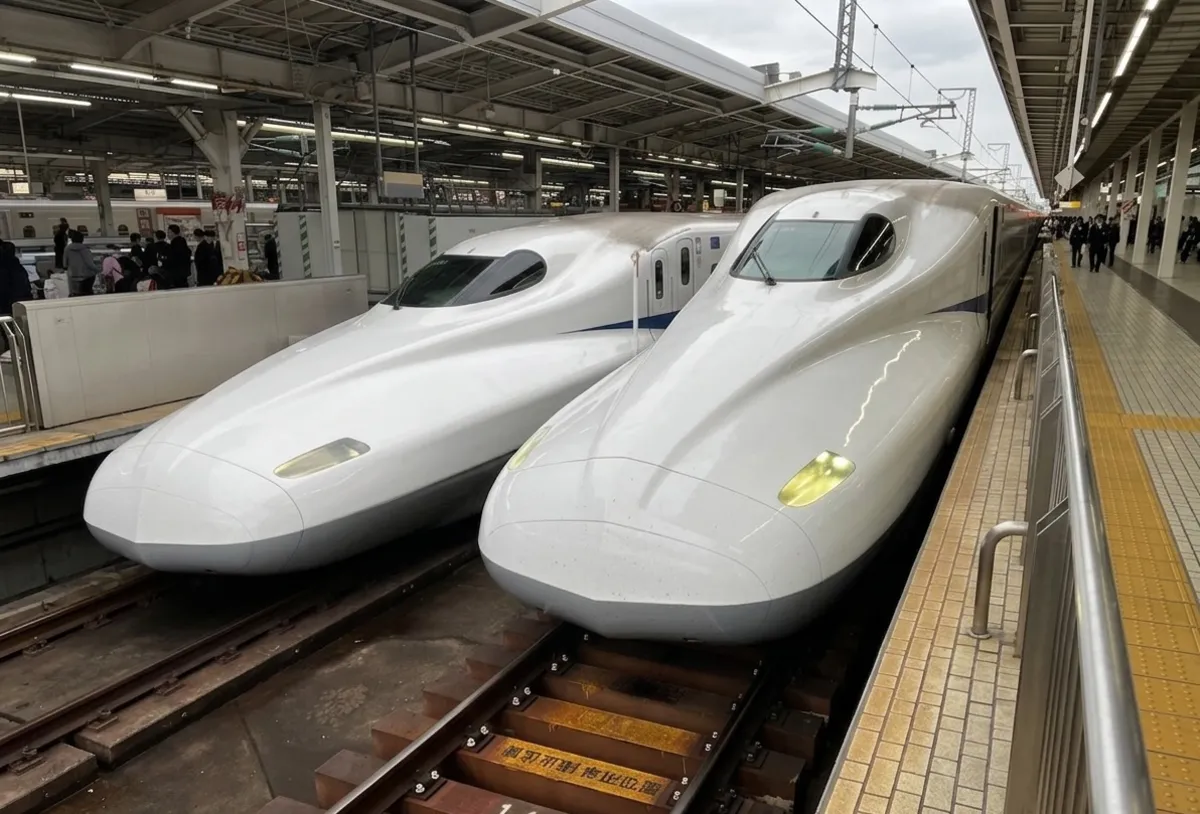
N700S
Hitachi / Kawasaki, 2020
Tokaido and Sanyo Shinkansen - Nozomi, Hikari, and Kodama services between Tokyo and Hakata.
The current standard on Japan's busiest corridor. 16 cars, 300 km/h, onboard power throughout. The S-variant introduced improved braking, battery backup, and refined ride quality over the earlier N700A.
A/CYes
PowerYes
DiningNo (ended Oct 2024)
WheelchairYes
E5 / H5 series
Hitachi / Kawasaki, 2011 / 2016
Tohoku and Hokkaido Shinkansen - Hayabusa (Tokyo to Shin-Aomori and Shin-Hakodate-Hokuto) and Komachi (coupled to Hayabusa as far as Morioka).
320 km/h - the fastest Shinkansen in service. All seats reserved; no unreserved option. 10 cars including one Gran Class car. The H5 variant is operated by JR Hokkaido on the Hokkaido extension.
A/CYes
PowerYes
DiningNo
WheelchairYes
E7 / W7 series
Hitachi / Kawasaki, 2014
Hokuriku Shinkansen - Kagayaki, Hakutaka, and Toki services between Tokyo, Kanazawa, and Tsuruga.
260 km/h. 12 cars including one Gran Class car. E7 operated by JR East; W7 by JR West - identical specifications. The Kagayaki is the fastest service with fewest stops; Hakutaka stops at more stations along the Sea of Japan coast.
A/CYes
PowerYes
DiningNo
WheelchairYes
Japan's Shinkansen routes
Route guides and planning pages for Japan's Shinkansen corridors.
Tokaido / SanyoTokaido / Sanyo3routes
Tokaido Shinkansen
Tokyo
→Kyoto
JR Central
Japan's most iconic rail leg: 513 km in 2h 15m on the Nozomi. Hikari takes 2h 40m and is JR Pass-eligible. Same carriages, same seats - just fewer stops. Sit right for Mount Fuji heading west.
Anchor route for most Japan itineraries: 2h 30m on Nozomi, 3h on Hikari. Tokyo-Osaka is the break-even test for the JR Pass - a return costs around ¥28,000, comfortably short of the 7-day pass on its own.
The stop for the Peace Memorial and Miyajima: Around 1h 25m on Nozomi. Hiroshima sits inside a comfortable day trip from Kyoto or Osaka, or a two-night side leg from Tokyo.
1h 25mFrequent
Guide soonReview
Tohoku / HokkaidoTohoku / Hokkaido3routes
Hokkaido Shinkansen + Limited Express Hokuto
Tokyo
→Sapporo
JR East / JR Hokkaido
Japan's longest Shinkansen-connected run: 7h 36m total across two legs - Shinkansen to Shin-Hakodate-Hokuto, then Limited Express Hokuto north to Sapporo. Crosses the Seikan Tunnel 140m below the Tsugaru Strait. JR Pass covers both legs.
The stop for Miyagi and the Tohoku coast: 1h 30m on Hayabusa. Sendai puts you within reach of Matsushima Bay, one of Japan's three official scenic views, and the starting point for Tohoku exploration.
1h 30mFrequent
Guide soonReview
Tohoku Shinkansen
Tokyo
→Shin-Aomori
JR East
Northern Honshu terminus and Hokkaido gateway: 3h 10m on Hayabusa. Connection point for the Hokkaido Shinkansen. Aomori is worth a night for Nebuta Museum Wa Rasse before the onward journey north.
3h 10mFrequent
Guide soonReview
Hokuriku / KyushuHokuriku / Kyushu2routes
Hokuriku Shinkansen
Tokyo
→Kanazawa
JR East / JR West
Japan Alps and the Sea of Japan coast: 2h 30m on Kagayaki. Kanazawa is where you set out for the Noto Peninsula and the Kenroku-en garden. A quieter alternative to the Kyoto circuit.
2h 30m~Hourly
Guide soonReview
Kyushu Shinkansen
Hakata (Fukuoka)
→Kagoshima-Chuo
JR Kyushu
Southern Japan's flagship run: Around 1h 20m on Mizuho. Kagoshima sits within reach of Sakurajima volcano and the southern hot-spring belt. Note: Mizuho is not covered by the JR Pass - use Sakura instead.
1h 20mFrequent
Guide soonReview
Reviews & First-Hand Reports
Reviews and route guides covering Japan's rail network.
MAY 2026
Tokyo to Osaka by Shinkansen: Fares, Times and How to Book (2026)
Japan's busiest bullet train corridor in one guide. Nozomi journey times, Green Car vs Ordinary fares, booking steps and a first-hand Green Car review.
Tokyo to Sapporo by Train: Tickets, Times and the Transfer You Need to Know
There is no direct bullet train to Sapporo yet. This guide covers the two-leg journey, the transfer at Shin-Hakodate-Hokuto, JR Pass costs and what to...
Tokyo to Kyoto by Train in 2026: Tickets, Times & What to Expect
Tokyo to Kyoto Shinkansen in 2026: fares, booking methods, JR Pass maths, and the seat to pick for Mount Fuji. Straightforward route guide from Planet...