
Route Overview
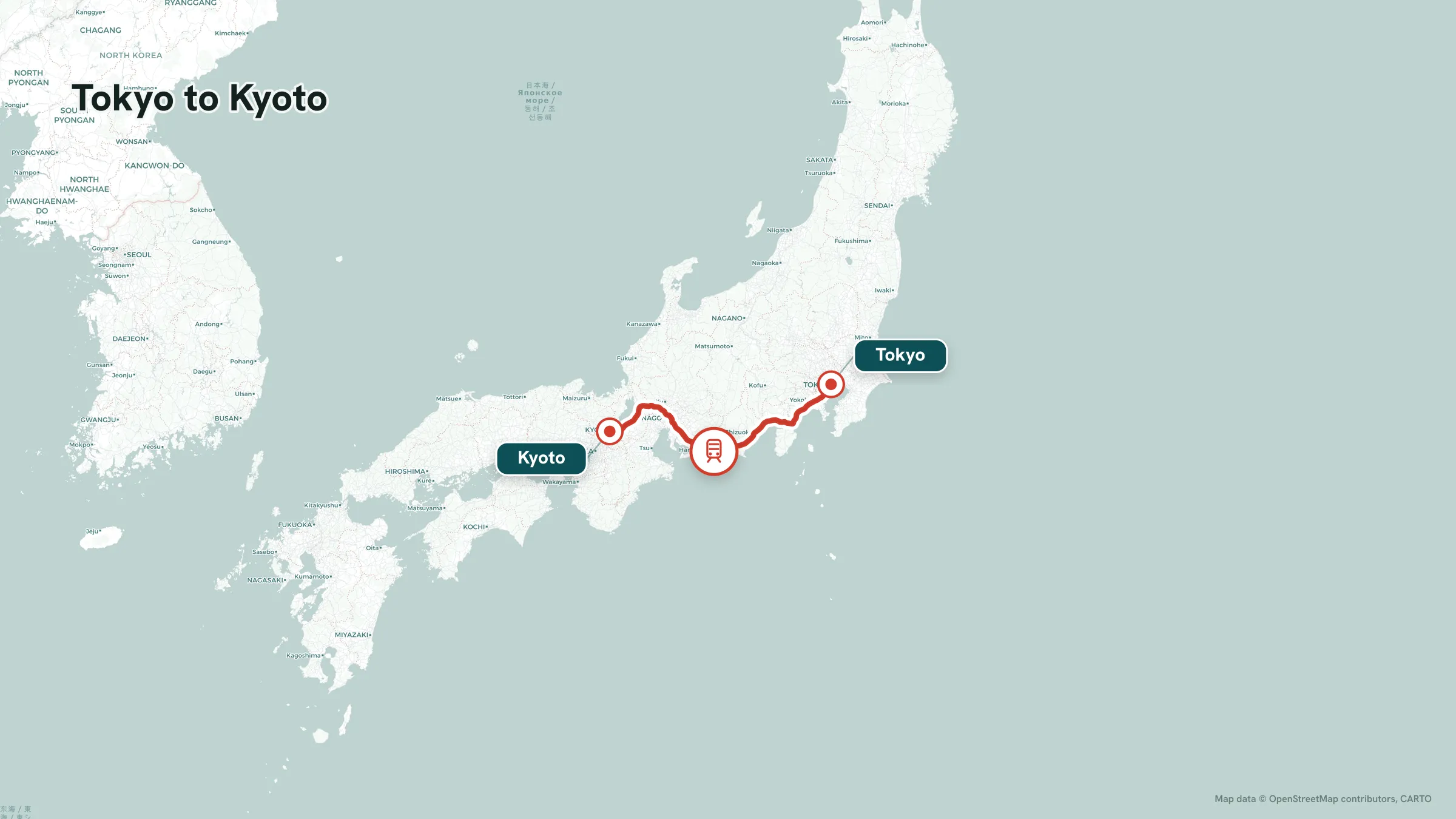
The Tokaido Shinkansen route: Tokyo to Kyoto via Nagoya.
The Tokaido Shinkansen covers 513 km from Tokyo to Kyoto in 2h 15m on the fastest Nozomi service, 2h 40m on Hikari. Trains depart Tokyo Station every 10 minutes at peak, roughly every 15 minutes off-peak. The fare is ¥14,170 ($94) in a reserved Ordinary seat, identical whether you take Nozomi or Hikari.
This is the anchor leg of most first Japan trips, and the decision that shapes everything else. Get it right - pass or no pass, seat side, ticket class - and the rest of your itinerary falls into place.
Expect a smooth, punctual, clean ride. Expect to pay more than you would for a low-cost domestic flight. Expect to arrive in the middle of Kyoto, on the same concourse as the JR Nara line platforms and the bus stands for Arashiyama. No airport transfer required. If you're basing yourself near the station, find hotels around Kyoto Station.
- Train
- Tokaido Shinkansen
- Service
- Nozomi (fastest)
- Rail Pass
- Hikari/Kodama only
- Reservation
- Recommended, not essential
- WiFi
- Free, patchy in tunnels
How to Book
SmartEX (official app)
Full English support, Hayatoku early-bird discounts up to ¥7,000 off Green Car, book up to one month ahead. Best for planners.
Midori no Madoguchi (counter)
Staffed counter at Tokyo Station. Cash, card, or IC, English help, same-day walk-up. Best for last-minute or first-time visitors.
With a JR Pass
Pass covers Hikari and Kodama only, not Nozomi. Exchange your voucher then reserve a seat at the counter for free.
Journey Timeline
Seating Classes
Onboard Experience
What the ride is actually like
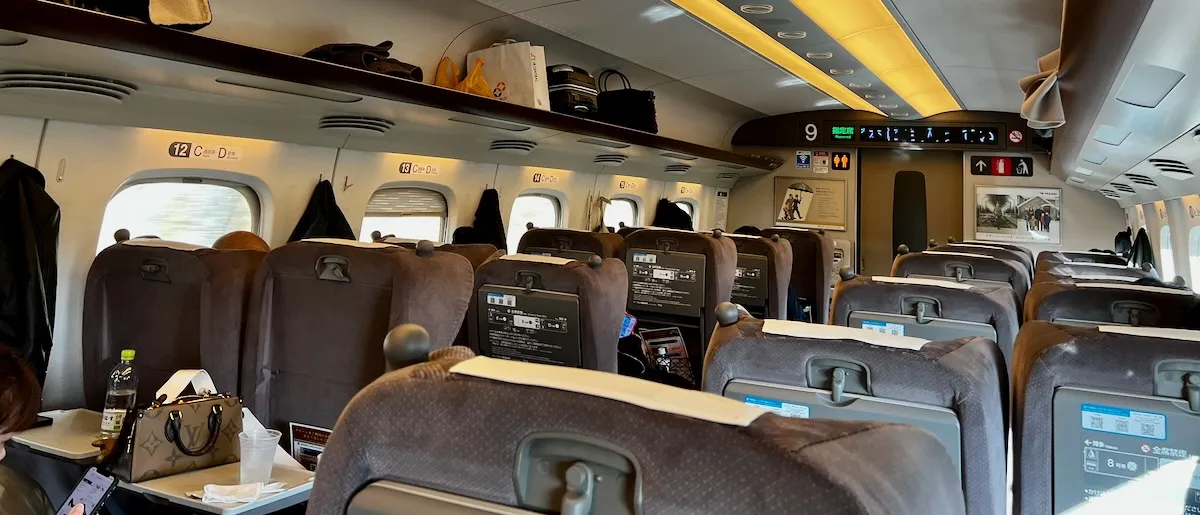
Every seat in every class has a power outlet and enough legroom to work a laptop without contorting. Free WiFi (Shinkansen Free Wi-Fi) needs a one-time email registration on first use, then connects automatically thereafter. Expect it to drop in the tunnels between Odawara and Shizuoka - plan accordingly if you are on a video call.
Onboard food and drink service ended in October 2024. Trolleys no longer run through the carriages. This catches a lot of travellers out because older guides still describe the bento service.
Buy your ekiben before boarding - Gransta market inside Tokyo Station's ticket gates has the widest selection, and there are platform kiosks on the Shinkansen platforms. Bring your own water; vending machines are on the platform, not onboard.
The ride itself is almost disappointingly smooth. At 285 km/h you can balance a coffee cup on the tray table. You can read, type, nap, or watch rice paddies and tea fields blur past. Toilets are in alternating carriages and signed in English, as are the seat-number panels and platform announcements.
Train vs Plane: The Real Comparison
For a single leg between Tokyo and Kyoto, the train wins on almost every measure except raw airtime. Even the cheapest LCC fare arrives at a distant airport, and the door-to-door time closes the gap. Take the Shinkansen.
- City-centre to city-centre travel with no transfers
- Luggage-heavy trips (two large bags free)
- Working onboard: free WiFi and power at every seat
- Seeing Mount Fuji from Seat E
- Low-carbon travel (~4 kg CO2 vs ~90 kg by air)
- The cheapest possible fare is the only thing that matters
- You already have a long-haul flight connecting through Haneda or Narita
If You're Connecting
Kyoto is a convenient springboard. Shin-Osaka is a 15-minute hop on the same Tokaido Shinkansen line, which makes a day trip to Osaka easier than most Tokyo commutes. Hiroshima sits 1h 40m south on the Sanyo Shinkansen, putting the Peace Memorial and Miyajima inside a two-night side trip.
For nearer-by classics, the JR Nara line runs to Nara in 45 minutes for under ¥800 ($5). The JR Sagano line takes you to Arashiyama in 15 minutes. Neither needs a Shinkansen.
I'm hoping to add full guides on Kyoto to Hiroshima and Kyoto to Osaka for timetables, booking, and seat advice very soon.