
Route Overview
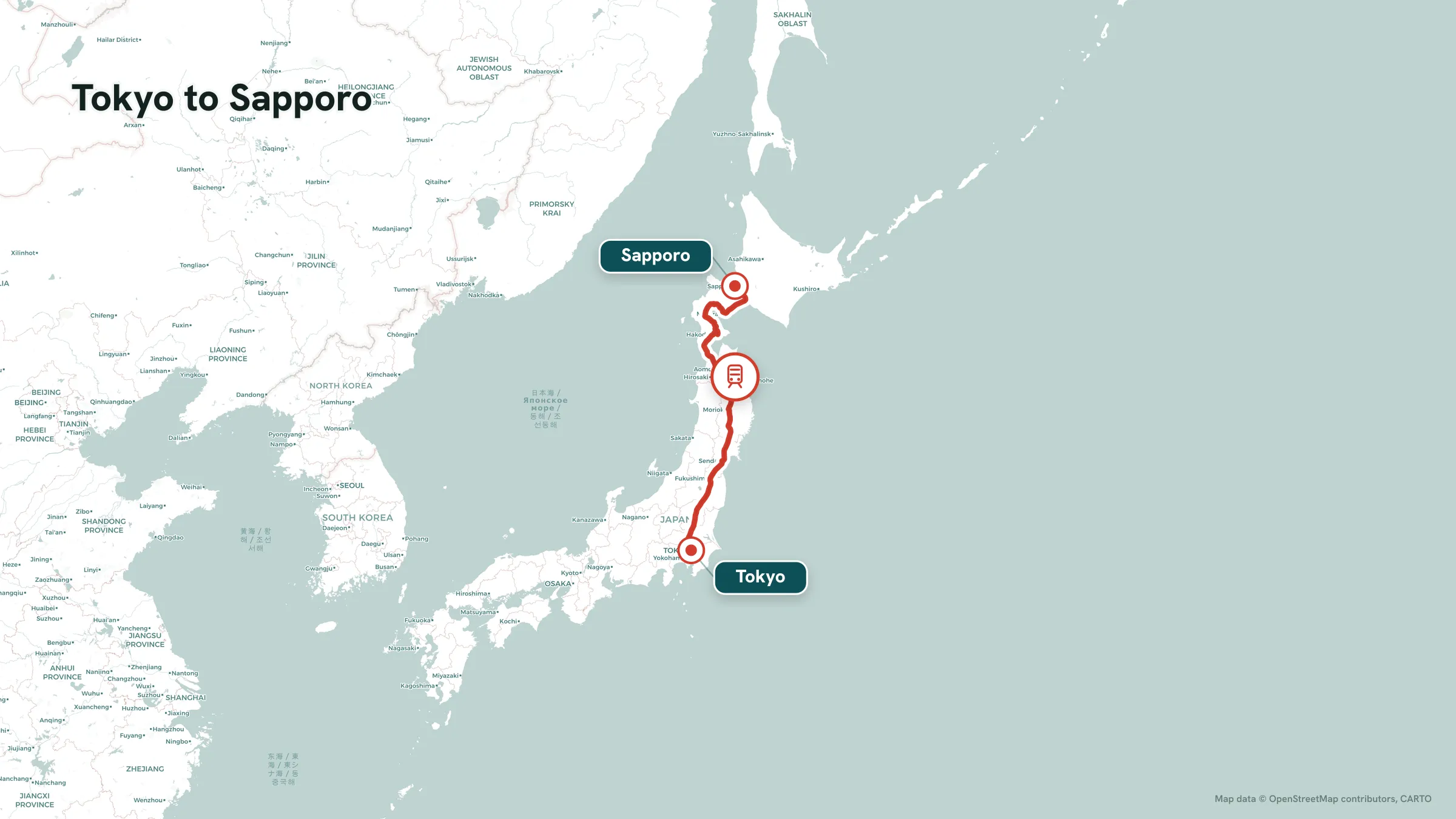
Tokyo to Sapporo: Hokkaido Shinkansen to Shin-Hakodate-Hokuto, then the Limited Express Hokuto on to Sapporo.
I haven't taken this route yet, but it is firmly on my radar for my next trip to Japan. Here's what my research and passenger reviews say.
There is no direct bullet train from Tokyo to Sapporo yet. The journey runs in two legs with one transfer. You take the Hokkaido Shinkansen from Tokyo Station as far as Shin-Hakodate-Hokuto, then change to the Limited Express Hokuto for the final stretch into Sapporo. Total time is about 7 hours 36 minutes, and the standard through-ticket fare is ¥27,760. Booking separate tickets for each leg costs more (around ¥38,770 combined) and is only worth considering if you are stopping at Hakodate for several days before continuing to Sapporo.
The standout moment on the journey is the Seikan Tunnel, a 53.85 kilometre crossing under the Tsugaru Strait at a depth of 140 metres below sea level. Transit takes roughly 25 minutes. It is the longest undersea rail tunnel in regular passenger service anywhere, and the announcement on the train is worth listening for as you pass through.
The JR Pass covers both legs in full. You'll need to reserve a seat for the shinkansen segment, which is free with the pass but mandatory before boarding. If you would rather skip the pass and book individual tickets, you can book in advance via the JR-EAST internet booking site. Sapporo flights run under two hours city to city, so the train is a deliberate choice rather than the fastest option.
The direct shinkansen extension to Sapporo is planned for around 2039, delayed by tunnel construction. The two-leg route will be the way to reach Sapporo by rail for the foreseeable future.
- Train
- Hokkaido Shinkansen + Limited Express Hokuto
- Service
- One transfer at Shin-Hakodate-Hokuto
- Journey
- approx 7h 36m total
- Frequency
- Several departures daily
- WiFi
- Free on shinkansen leg
- Power
- At every seat on shinkansen
How to Book
JR Pass (best for multi-city trips)
Both legs covered. Reserve a seat for the shinkansen segment for free at any JR ticket office. Buy the pass from the JR Pass website before travelling.
Individual tickets, advance online
Book each leg separately via the JR-EAST internet booking site. Advance purchase saves over walk-up fares. Print tickets or use IC card QR at automated gates.
Tickets at the station on the day
Machines and staffed windows at Tokyo Station. Unreserved carriages exist but fill fast in peak season. Reserve if travelling December to January or during Golden Week.
Journey Timeline
Seating Classes
Onboard Experience
What the Journey is Actually Like
The shinkansen leg is the polished part of the trip. Hayabusa services run smooth and quiet at speed with reclining seats, legroom, and power at every seat. The Seikan Tunnel announcement is worth listening for as the train enters the crossing. Inside the tunnel itself there is nothing to see. The train just keeps going for about 25 minutes in the dark.
The transfer at Shin-Hakodate-Hokuto is a platform change inside the same station, with bilingual signage. The Limited Express Hokuto typically waits on a nearby platform. A short connection of 10 to 15 minutes will get you straight onto the next train, while a longer 30-minute window gives time for a coffee or a quick onigiri from the station kiosk. The walk between platforms is short.
The Hokuto leg has a different feel. The rolling stock is older, the ride is slower, and the rural rhythm of southern Hokkaido takes over. You move past dairy farms, river valleys, and Uchiura Bay before the suburban outskirts of Sapporo appear. It is not the polished shinkansen experience, but the texture of the journey changes in a way that suits the geography.
Is the Train Worth It?
The journey is around 7.5 hours with one real transfer, so it is not the fastest way to reach Sapporo. But it passes through the Seikan Tunnel, arrives city centre to city centre, and JR Pass holders pay nothing extra for either leg. For rail travellers who are already in Japan and already on a pass, it makes sense.
- JR Pass holders. Both legs are included with no extra cost
- Travellers wanting to see Hokkaido's landscape at ground level
- Anyone making multiple shinkansen trips across Japan
- Passengers who prefer station arrivals over airport processing
- Time is your main constraint. Sapporo flights run under two hours city to city
- Transfer logistics make you anxious. The connection adds real friction
From Sapporo
Sapporo Station puts you under the JR Tower in the city centre, with underground shopping concourses linking out to Odori Park, Susukino, and the major hotels. Most central accommodation is a short walk or a single subway stop away. Find hotels near Sapporo Station if you have not booked yet.
For onward rail from Sapporo, the JR Hakodate Line runs out to Otaru in around 30 minutes, the Limited Express Suzuran takes you to Noboribetsu hot springs in 1 hour 20 minutes, and the Limited Express Hokuto runs back to Hakodate in roughly 3 hours 30 minutes. All are covered by the JR Pass if you still have days remaining.
For other long-distance rail journeys on Planet Patrick, see the Montreal to Quebec City by train guide for a Canadian corridor comparison, or the Belfast to Dublin by train route for a European cross-border equivalent.
How long does the Tokyo to Sapporo train take?+
About 7 hours 36 minutes total, including the platform change at Shin-Hakodate-Hokuto. The shinkansen leg runs roughly 4 hours 2 minutes, and the Limited Express Hokuto adds another 3 hours 34 minutes.
When will a direct shinkansen to Sapporo open?+
The extension is currently planned for around 2039, delayed from an earlier 2031 target by tunnel construction challenges. About 80 percent of the 212 kilometre extension is in tunnels, which is the bottleneck.
Can I send my luggage ahead to skip the transfer?+
Yes. Takkyubin courier services from Tokyo Station deliver bags to your Sapporo hotel next day for around ¥5,200 per piece - this is the long-distance rate for the Tokyo to Sapporo run. It removes the transfer-with-suitcase problem entirely if you are willing to spend the night without your main bag.