
New Zealand by Train: Northern Explorer Train from Auckland to Wellington
One of the world's great rail journeys, end to end across New Zealand's North Island. Here's what the trip is actually like, and how to plan it.

The Northern Explorer is celebrated as one of the world's top scenic train journeys, and with good reason.
The journey spans 680 kilometres between Auckland and Wellington, and gives train enthusiasts (like me) the perfect window seat to see New Zealand's fascinating landscapes, from volcanic terrain to Hobbitesque shires.
I like little touches of luxury and, on board the Northern Explorer, even standard class benefits from panoramic windows and access to a decent dining car.
This train journey is less about fast travel between two big cities (a plane would be faster), and more about an unforgettable journey across New Zealand's North Island.
My essential guide has everything you need to know about what to expect on board, highlights along the way, and how to plan your trip.
Overview of the Northern Explorer Train Journey
The Northern Explorer is part of the Great Journeys of New Zealand, which operates the three long-distance train experiences in the country. It departs from Auckland Strand Station and travels south to Wellington, passing through stunning national parks, farmlands, and across a surprising number of gorges.
Note: my review is about the Auckland to Wellington route, but the Northern Explorer also runs Wellington to Auckland three times per week.
Travel time is just over 10.5 hours, with departures from both Auckland and Wellington three times a week. Tickets can be booked online in advance, with fares starting at NZD $219 depending on class and booking time. Scenic Plus (with dining) may be available when you book (it was not available on this route when I travelled in November 2023 but was available on the Tranzalpine route and I tried it then).
This long journey is well-paced, with several key stops along the way at places like Hamilton, National Park and Ohakune. Passengers travelling the full journey will be able to stretch their legs in a couple of places. However, time goes by pretty quickly as you want the landscapes unfold from the comfort of your seat, or even better, outside in the open-air viewing carriage.
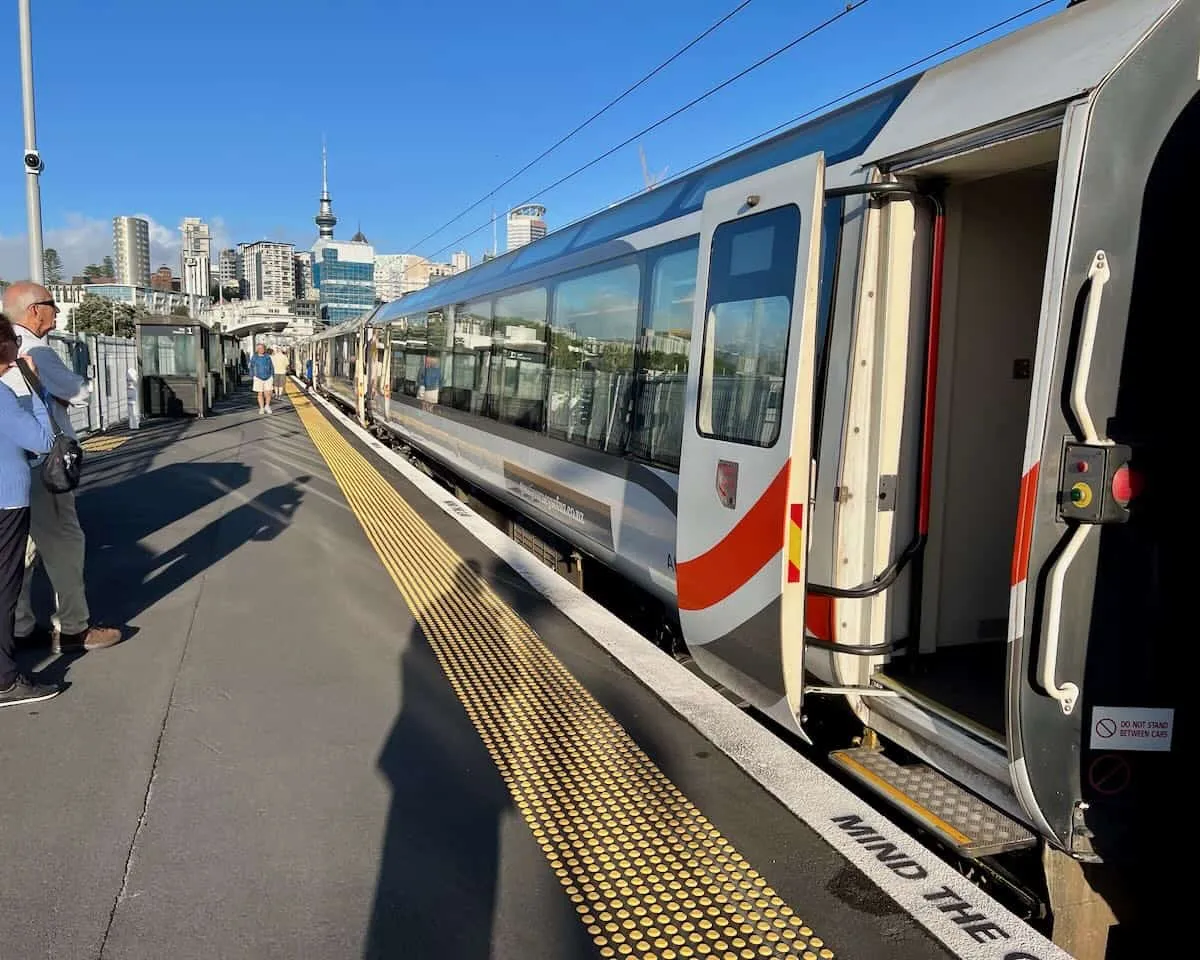 Photo: Patrick Hughes - boarding at Strand Station, Auckland
Historical and Cultural Significance of the Route
The Northern Explorer route is not only a scenic journey but also one steeped in history and engineering marvels. The North Island Main Trunk railway, only fully completed in 1908, played a crucial role in connecting the northern and southern parts of the island. Before its completion, it took substantial effort to travel between Auckland and Wellington via a long sea journey or overland by horse and carriage.
One of the most impressive sections of the trip is the Raurimu Spiral, a world-famous railway engineering feat that helped trains ascend steep grades without the need for extra engines. The spiral uses a clever combination of tight loops, tunnels, and gradients to raise the track over a significant elevation in a short distance.
A side note: we passengers were made aware of the spiral and were aware of the steep section, but it's hard to "see" or visualise the spiral while you're actually on board.
Additionally, the train passes through areas rich in Māori heritage. The Tongariro National Park, for example, is not only home to active volcanoes but also holds great cultural significance to the Māori people of Aotearoa. In 1887, the Māori tribe, Ngāti Tuwharetoa, sought to preserve the area's natural beauty and spiritual significance in partnership with the New Zealand government.
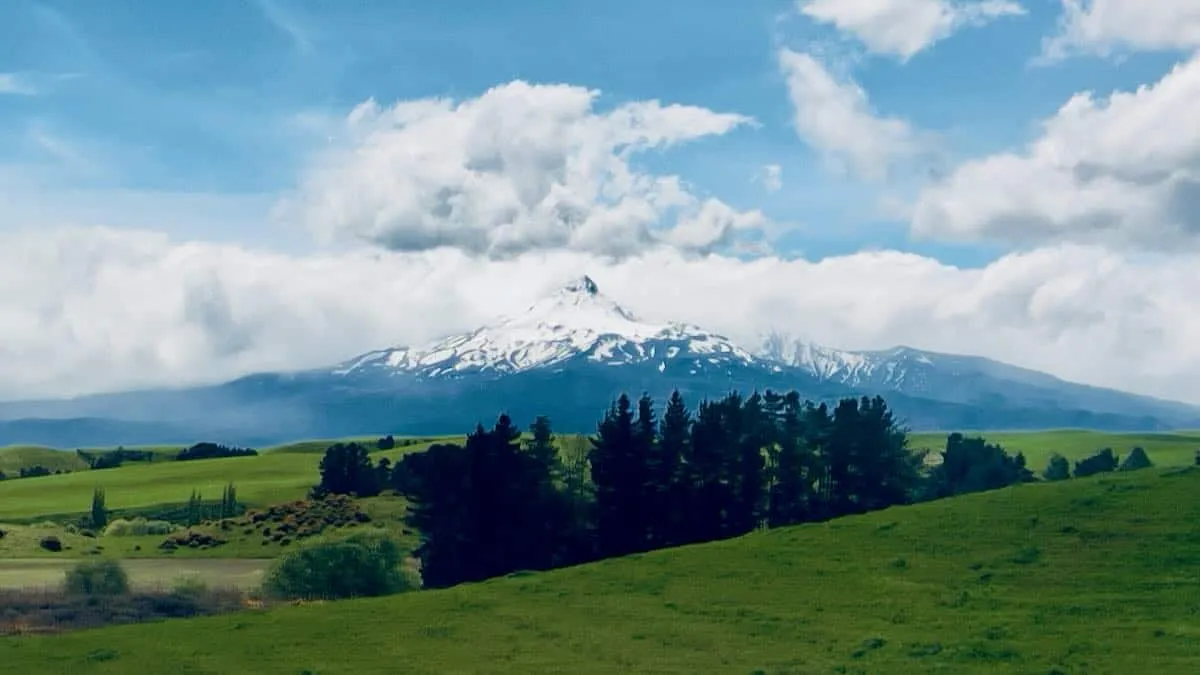 Photo: Patrick Hughes - Mount Ruapeha from the train
What to Expect Onboard the Northern Explorer
Comfort in Standard Class
Standard class on the Northern Explorer has decent comfort for such a long journey. The train is reminiscent of a slightly older UK train product in terms of the seat, but with the joy of panoramic windows to make for relatively unobstructed views.
Note: when I got on board, someone had taken my window seat, which I had gone to great lengths to select ahead of time. With a minor grumble, I regained my seat, but be aware you CAN reserve your seat place, and expect to have that seat!
Maybe it's just me, but I couldn't get the seat to recline (for a mid-journey nap). In terms of facilities, there's a tray table big enough for a meal or a small laptop, and enough room at your feet for a small backpack.
Wi-Fi is not available on this train, and my phone could not connect to data outside of towns or stops. The train goes through rural New Zealand, so this is to be expected.
Facilities and Services on the Train
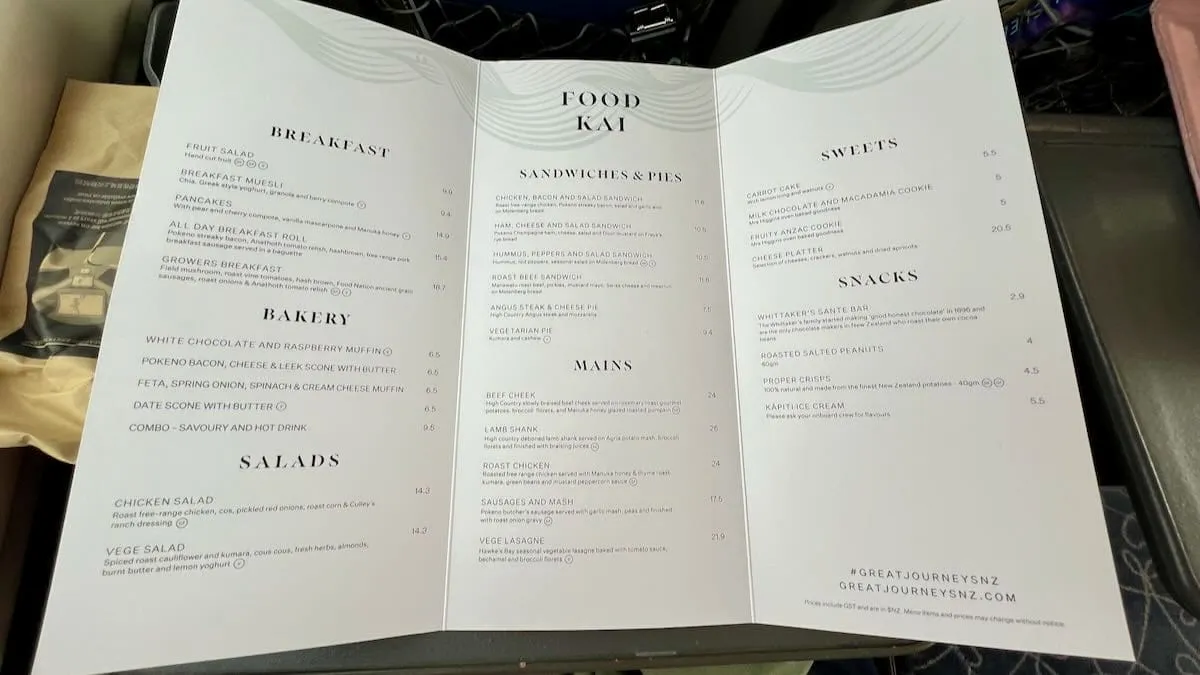 Photo: Patrick Hughes - the menu showing what's available in the onboard cafe
The Northern Explorer has an onboard café serving hot and cold food, drinks, and snacks. No meals or drinks are included in standard class, so you'll have to pay. This is essential for such a long journey, as you're on board for at least one main meal time, plus snack times!! Note: I also brought snacks with me.
Top Tip: As there's no Wi-Fi on board, bring cash, because the credit card machine doesn't always work (and they won't sell you anything without paying for it first).
If you're travelling in Scenic Class, then all of your dining and some drinks are included (but I'd still bring snacks to keep you going!).
The Open Air Viewing Carriage
One of my favourite spots onboard the Northern Explorer is the open-air viewing carriage. I was in Carriage A, and it was located right next door at the back of the train.
The open-air carriage is the spot for stepping 'outside' to take pictures, but getting a breath of fresh New Zealand air is the best part when you're spending most of the day inside a crowded carriage.
There is a helpful 'buzz' or 'beep' in every carriage just before you come to a standout location, giving you time to get from your seat to the open air platform.
Some stretches are less interesting and/or the weather can be full-on (we got sunshine and heavy showers during my trip). While the carriage has a roof, you can get wet (and at this speed, you might feel cold, even in summer), so do take a couple of light layers with you if you want to brave the damper moments. See my packing list for some hints and tips.
Luggage
There are luggage limitations on the Northern Explorer. Your bags are tagged at check-in and you bring them (yourself) to the separate luggage car at the front of the train before you board.
Standard passengers ("scenic class") get an allowance of one large suitcase of 23kg and one cabin bag of 7kg. Scenic Plus passengers can take a second large suitcase.
You are permitted to take one SMALL bag on board the train, which should contain your necessities, which could include any meds you need, snacks, a camera, etc. On my train, people were not all compliant with the 'small' part of that request!
Once you put your bags into the luggage car, you will not have access to them until you reach your destination.
Accessibility
Scenic Class carriages are fully wheelchair accessible but note that the Scenic Plus (dining) carriages are NOT. However, the cafe has dedicated wheelchair spaces. The train company has additional advice for wheelchair, power chair or mobility scooter users here.
Scenic Highlights from the Train
Throughout the journey, you'll be able to see amazing New Zealand views, including the famous Raurimu Spiral, Tongariro National Park, and the Kapiti Coast. The Tongariro National Park segment is particularly striking, as the train skirts active volcanoes like Mt. Ruapehu.
The onboard commentary gives you plenty of warning about which way to look and what to see, which I found very helpful. This section of the journey provides some of the best opportunities for photography, especially from the open-air carriage.
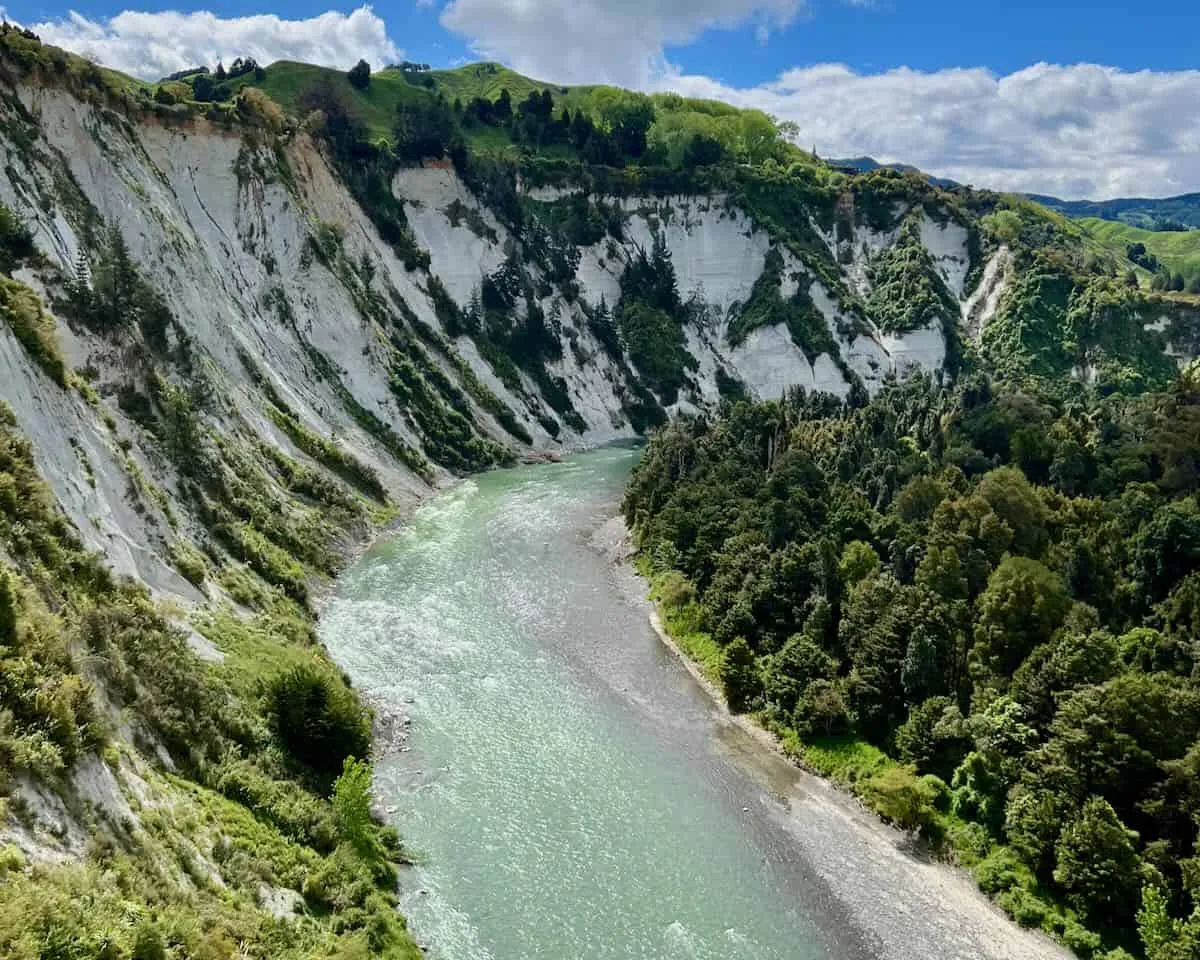 Photo: Patrick Hughes - a gorge view from the open-air carriage
Scenic Highlights Along the Route
Highlights of the North Island
From the moment the train departs Auckland, the scenery quickly shifts from suburbia to rolling farmlands (familiar to Hobbit or Lord of the Rings fans), with lots of trees and green hills. As the Northern Explorer passes through the Waikato region, passengers will experience "big sky country" with pastures and distant hills.
Further along the route, the train skirts the edge of the Rangitikei River, known for its dramatic cliffs and winding path. Approaching the southern end of the journey, after Paraparaumu station, you should be able to see coastal views of the Kapiti Coast as the train makes its final approach into Wellington.
Tongariro National Park and Volcanic Landscapes
One of the most stunning parts of the Northern Explorer journey is when the train travels through Tongariro National Park. This UNESCO World Heritage site is known for its dramatic volcanic landscapes, including Mount Ruapehu, an active stratovolcano and one of New Zealand's most iconic natural landmarks.
During winter, the peaks of Ruapehu and the surrounding mountains are snow-capped. I travelled in November (late spring) and the top was still coated in white! Even in high summer, when it's likely the slopes of the mountain are covered in green vegetation, the view of Ruapehu from the train should be stunning.
Best Time of Year to Take the Northern Explorer
The Northern Explorer operates year-round, but the best time to take the journey depends on your preferences. Summer has warmer temperatures and greener landscapes, while winter delivers snow-capped peaks and the chance for views across frosty fields.
I went in late Spring (November) and got the green fields and a couple of white-topped mountains, so I feel I got the best of both worlds!
 A bit frazzled at Wellington Station after nearly 11 hours on board the Northern Explorer
Practical Tips (for International Visitors)
I visited New Zealand this time as part of a longer trip and arrived from Tasmania via Air New Zealand, so the jet lag wasn't too serious.
However, if you're coming from further afield, give yourself enough time to adjust to the timezone by staying a day or two in Auckland (I stayed near SkyCity) so you can enjoy the Northern Explorer without the dreaded jet lag (find out more about smart stopovers en route to New Zealand).
Booking Tickets and Reserving Seats
If anyone tells you to book on the day or the day before, don't believe them. While there's a chance you could get lucky, many of the 3-times weekly journeys in either direction sell out. So pre-book, and do so early if want to travel during peak travel season (around holidays and in summer).
You can book online through the Northern Explorer's official website here.
Note: when I travelled, Scenic Plus (dining) was available ONLY on the Tranzalpine journey from Christchurch to Greymouth, but it now appears to be available on other routes.
Getting to the Train Station from Auckland Airport
Look, it's not that I'm risk averse, but I think it would be playing with fire to try to fly to Auckland Airport on the morning of your Northern Explorer trip (which departs at 7.45am). However, if you're staying at an airport hotel, and if there's more than one of you, book a taxi to get to you to Strand Train Station.
Otherwise, most international visitors should arrive a day or two in advance and use my advice on how to get from Auckland Airport to downtown to find the best transport for their needs (and budget).
What to Pack for the Northern Explorer
For a 10+ hour journey, you'll need a few essentials. First, bear in mind, you can only take a small bag on board with you (everything else gets checked into the luggage car). You'll need a camera and/or smartphone to capture some stunning views, a power bank for charging devices, and snacks or drinks for the journey.
If you plan on using the open-air carriage, pack a light jacket or windbreaker, as it can get cold being outside during the journey, even in the summer.
Frequently Asked Questions
The full journey takes around 10 hours and 40 minutes. The train departs Auckland at 7.45 am and arrives in Wellington at 6.25pm. Our train was slightly delayed getting into Wellington, so build that into your arrival plans.
Yes, there is an onboard café offering a decent variety of hot and cold meals, drinks, and snacks. I found the lighter, salad options just okay. What I did was to supplement the Cafe offerings with my own snacks - I brought protein bars, nuts and bananas.
Summer and winter are both scenic - eg, summer is lush and green, while winter features snow-capped peaks. I went in November and got a bit of both!
Passengers are allowed to bring one piece of checked luggage and one cabin bag-sized item, to be checked in to the luggage car. You can bring one small bag on board containing any necessities. Scenic Plus customers get two pieces of checked luggage.
Only service animals are permitted on board. Bikes are permitted in the luggage car, but only if pre-booked, and this costs extra.
You'll pass through the Waikato region, Tongariro National Park, and the Kapiti Coast, among other scenic spots.
Use my detailed guide to get from Auckland Airport to the city centre, then take a taxi or Uber to Strand Station.
You don't have to travel the entire route. In fact, many passengers in my car got off at the National Park station to go hiking. Contact the train company for more details.
Conclusion
The Northern Explorer is more than just a way to travel between Auckland and Wellington - it's a journey through the heart of New Zealand's gorgeous North Island. Yes, I'm a train enthusiast, but you don't have to be. This is a unique way to see one of the most beautiful countries on earth.
From the comfort of your seat or the breezy open-air carriage, you'll see some of the North Island's most iconic views. If you're starting to plan your New Zealand itinerary, add this train journey to your list.