
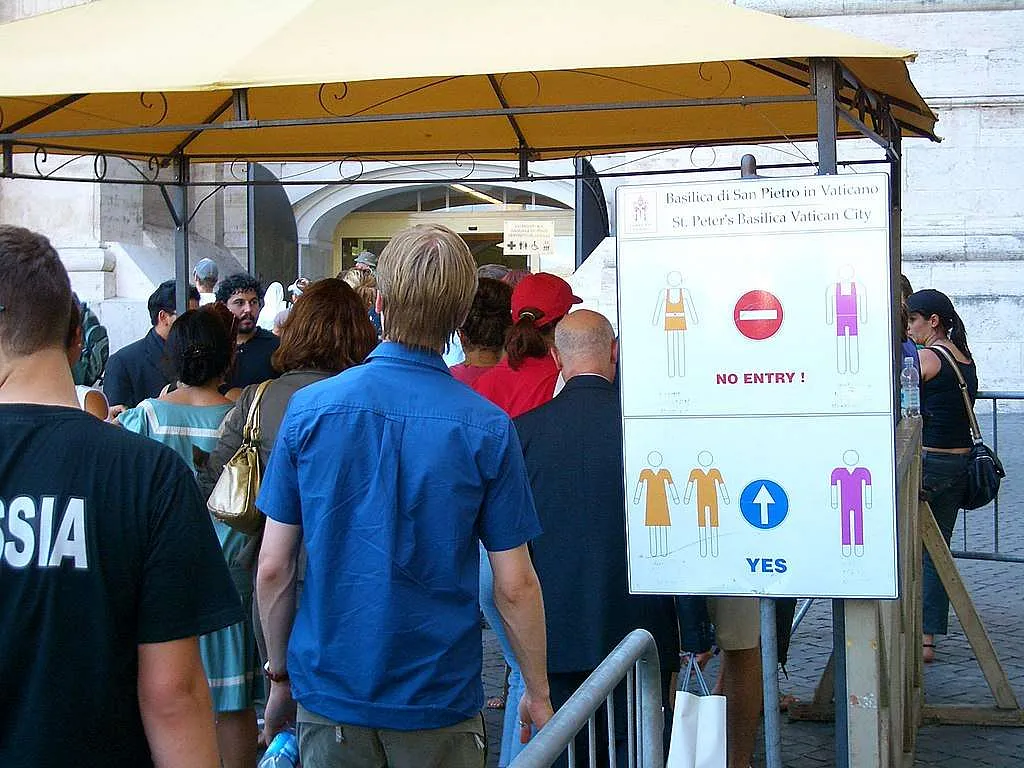
Every summer I watch the same scene at the Basilica entrance: someone who has been standing in a queue for 45 minutes reaches the door, gets assessed by the guard, and is told to step aside. Sleeveless top, usually. Sometimes shorts. Always avoidable. The Vatican dress code is real, it is enforced, and the guards are not going to make an exception because you didn't know.
The rules are simple. The enforcement is uneven. Here's what you actually need to know.
The official rules
Both men and women must have shoulders and knees covered. No sleeveless tops. No shorts above the knee. No low-cut necklines. No see-through fabrics. Hats must be removed inside the basilica - though they're fine in St Peter's Square and in the museum corridors.
These rules apply to St Peter's Basilica, the Sistine Chapel, and all churches within Vatican City. The Vatican Museums enforce the same requirements, though the level of scrutiny at the museum entrance is lighter than at the basilica door.
How enforcement actually works
The strict check happens at St Peter's Basilica. Guards are posted at the entrance and assess every visitor. Bare shoulders are the most common reason for being turned away. Shorts above the knee come second. There is no appeals process and there are no courtesy wraps provided at the door.
At the museum entrance on Viale Vaticano, the initial security screening is less thorough. I have watched visitors in shorts that would have got them stopped at the basilica pass through the museum queue without comment. But the Sistine Chapel is at the far end of the museum route, and the guards there apply a closer look. If you're dressed borderline, you could make it through three-quarters of the museums before being asked to leave.
The inconsistency is real, but I wouldn't count on it. Dress correctly from the start. There's no good outcome from reaching the Sistine Chapel only to be turned around.
The fix
Carry a scarf. A lightweight pashmina or large scarf takes up no meaningful bag space and solves every dress code problem. Wrap it around bare shoulders. Tie it as a makeshift sarong over shorts. You will pass every Vatican entrance.
If you've forgotten one, there are street vendors on Via di Porta Angelica - the road that runs alongside the outer wall towards the basilica. They sell basic shawls specifically for this purpose. Expect to pay EUR5 to EUR10. They know exactly why you need one. Buy before you queue, not after you've been refused.
Does the season change anything?
The dress code doesn't change with the season, but the problem does. In summer - June through September - enforcement is most visible because the violations are most frequent. Rome is hot and people dress for the heat. The Vatican expects you to dress for a church. This gap is where most refusals happen.
In winter, the dress code is rarely an issue. If you're visiting between November and March, you're almost certainly already wearing clothes that meet the requirements without thinking about it. Spring and autumn are the middle ground - usually fine, but check before you leave the hotel.
Papal audiences
If you're attending a papal audience, the dress code is similar but enforcement is softer. The logistics of checking tens of thousands of people filing into an open square are different from checking a single basilica door. Shoulders and knees covered is the expectation, but you're unlikely to be challenged for a sleeveless top in the middle of a crowd in St Peter's Square the way you would be at the basilica entrance.
For a private audience or small-group meeting with the Pope, the dress code becomes formal. Women traditionally wear black with a veil. Men wear dark suits. This is protocol - it applies regardless of your faith or background, and the Vatican is explicit about it in its correspondence.
Where to stay nearby
Prati, directly north of the Vatican walls, is the most practical base. It's quieter than the tourist centre, has good restaurants a short walk from the main drag, and puts you five to ten minutes from both the museum entrance and St Peter's Square on foot. Borgo Pio is closer to the basilica but noisier at night. Both are far better options than staying near Termini and commuting across the city.
Map powered by Stay22. I earn a small commission if you book - it doesn't cost you anything extra.
Affiliate links - you book at no extra cost, I earn a small commission.
Worth booking
A guide will tell you the dress code in their pre-visit briefing. I have never seen a professionally guided group turned away at the door - because the guide catches any issues before the entrance. If you want the Vatican Museums and Sistine Chapel without the logistics risk, these are worth considering.
Affiliate links - you book at no extra cost, I earn a small commission.
Getting there
Metro Line A to Ottaviano station, then a 10-minute walk following the crowds towards the walls. Buses 23, 49, and 64 stop at Piazza del Risorgimento, directly outside the museum entrance on Viale Vaticano. Taxis to "Piazza San Pietro" will drop you at the square itself.
One thing worth knowing: the museum entrance and St Peter's Square are at opposite ends of the Vatican walls, about 600 metres apart on foot. Many visitors assume they're side by side and are confused when they arrive. If you're doing both, plan your route before you set out. For how to sequence the whole visit, see the one-day Vatican itinerary.
Most people get turned away for the dress code once. After that, they always pack a scarf.