
PATRICK ANSWERS: If it's your first visit and you have limited time, yes - book a guide. The EUR 10-50 premium buys context that makes the art click, crowd management through the bottleneck galleries, and the Sistine-to-Basilica shortcut. If you've been before, or you want prayerful pace over historical narration, go independently with an audio guide.
The question isn't really "guided or not?" It's "what will I miss without one?" The Vatican Museums span seven kilometres of corridors. The Sistine Chapel sits at the far end of a route designed to overwhelm you before you arrive. And the art - from Raphael's theological arguments to Michelangelo's reluctant ceiling - was made for an audience that already understood the references. A guide translates. They also protect your time, which inside the Vatican is the resource that runs out fastest.
But a guide isn't always the right call. Here's how to decide.
Who should book a guided tour
First-time visitors with limited hours. If you have one morning in Rome for the Vatican, a guide is structural, not optional. They eliminate two to four hours of queuing, manage crowd flow through choke points, and ensure you see the essential spine without backtracking or exhaustion.
Families and older travellers. Guides adjust pace, build in seating breaks, and prevent the common mistake of trying to see everything. Children stay engaged with stories. Grandparents don't get crushed in the Gallery of Maps at noon.
Pilgrims seeking theological depth. I first walked through the Sistine Chapel as a seminarian and completely missed the point. I stared at the ceiling because everyone said to stare at the ceiling. It was years later, standing at the altar wall looking at the Last Judgment, that Michelangelo's actual argument hit me. The ceiling is the prologue. The altar wall is the sermon. A good guide makes that clear on your first visit, not your third.
Photographers and crowd-averse visitors. If your goal is to photograph the Raphael Rooms without obstruction or stand in the Sistine Chapel in actual silence, skip ahead to the early-entry and Friday night sections below. Those formats are the answer.
Who doesn't need a guide
If you've visited before and know what you want to see, if you're art-literate and prefer your own pace, or if your goal is contemplation rather than narration - you'll do fine independently. Winter visits, when crowds are manageable, also tilt the balance toward self-guided. I've written a complete self-guided Vatican visit guide covering route planning, timing, and the practical logistics.
What a guide actually gives you
The value isn't just narration. It's three things working together.
Context that changes what you see. In the Raphael Rooms, a guide explains not just the frescoes' beauty but their function: papal propaganda, theological argument, Renaissance humanism encoded in colour and gesture. In the Sistine Chapel, they clarify Michelangelo's reluctant genius, the ceiling's iconographic programme, and the altar wall's Last Judgment - a work so controversial it was censored after the artist's death. This is the difference between seeing and understanding.
Route control through the crush. The Vatican's architecture creates inevitable choke points: the Gallery of Maps, the Raphael Rooms, and the final approach to the Sistine Chapel compress thousands of visitors into narrow passages. Between 10:00 and 15:00, self-navigation becomes a slow, noisy ordeal. You won't linger at Raphael's School of Athens - you'll shuffle past it in a human queue. Guides solve this by positioning you strategically, accelerating through transitional spaces, and timing your Sistine Chapel entry to avoid the worst surges.
The Sistine-to-Basilica shortcut. Most guided tours include the internal passage from the Sistine Chapel directly into St. Peter's Basilica - a route closed to independent visitors. This alone saves 30-40 minutes of re-queuing outside and changes the flow of your entire day.
The cost reality
Standard group guided tours range from EUR 40 to EUR 150 (about $44-165) depending on provider and group size. Private tours command EUR 250+ (about $275+). Independent visitors can book skip-the-line tickets for EUR 24-31 via the official Vatican website, with audio guide rental (EUR 8) as a compromise.
The actual cost difference between guided and independent is often modest - perhaps EUR 10 to EUR 50. But the value gap is significant. A guided tour eliminates queuing (worth two to four hours), provides expert commentary, and structures your time efficiently. For budget-conscious travellers, the calculation is simple: a poor independent experience wastes money already spent on flights and accommodation. A guided tour protects that investment.
| Format | Cost (EUR) | Best for |
|---|---|---|
| Standard group tour | 40-80 | First-timers, budget-conscious |
| Small group (8-12) | 80-150 | Better pace, more questions |
| Private guide | 250+ | Families, specific interests |
| Skip-the-line + audio | 32-39 | Repeat visitors, own-pace |
The highest-value formats: early-entry and Friday night
Early-entry tours (07:00-08:00 start) are consistently the highest-value Vatican experience. You enter before standard opening, photograph the Raphael Rooms without obstruction, and stand in the Sistine Chapel whilst it's still a place of contemplation rather than a crowded theatre. The atmosphere is different in kind, not just degree.
Friday night after-hours tours (19:00 start) offer something rarer still: limited to 200 participants, these four-hour sessions grant near-exclusive access to the Museums and Sistine Chapel. The silence is startling. You can sit, look upward, and absorb Michelangelo's ceiling without distraction. For pilgrims, this is the closest you'll come to the Vatican's intended spiritual function. For cultural travellers, it's the difference between witnessing art and being overwhelmed by crowds.
Both formats command premium pricing. But if your budget allows only one splurge in Rome, spend it here.
Some access is guided-only
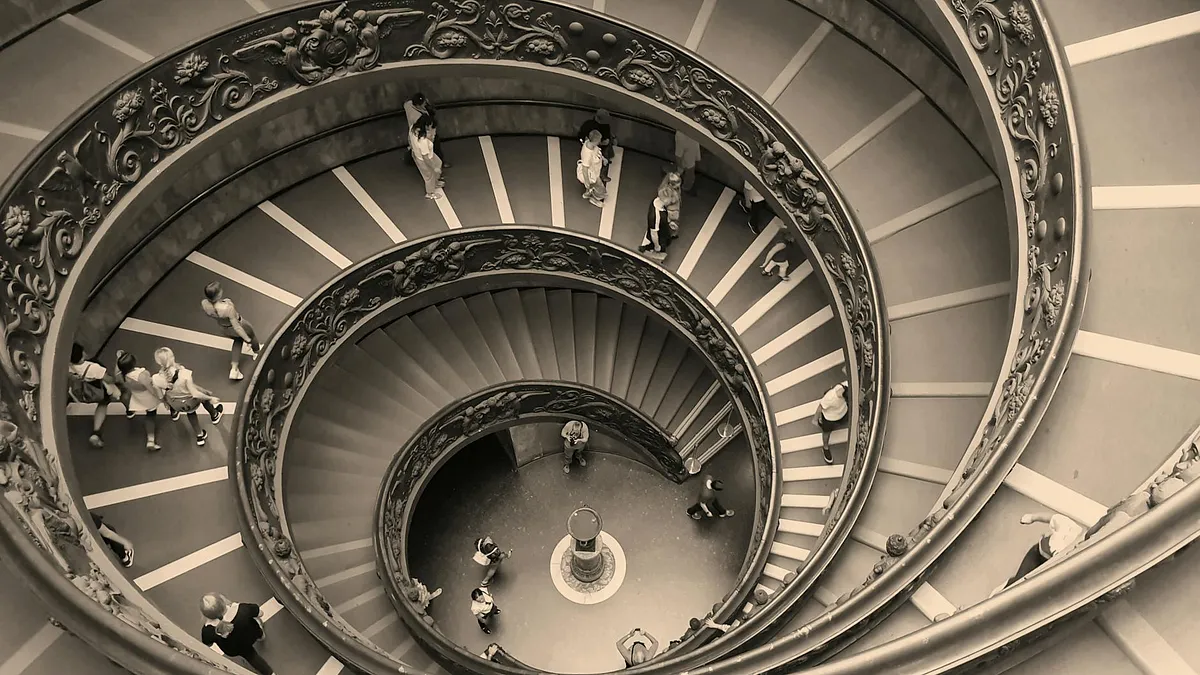
Certain areas of the Vatican are closed to independent visitors entirely. The Bramante Staircase - a double-helix architectural marvel - is invisible to general admission ticket holders. Parts of the Vatican Gardens require a guided booking. And the Scavi tour beneath St. Peter's is always guided, always intimate, and arguably the most extraordinary thing the Vatican offers.
If restricted access matters to you, a guide isn't a luxury. It's the only way in.
How to choose the right tour
Not all guided tours are equal. Here's what to look for:
Group size matters. Groups of 8-12 allow real-time questions and pacing adjustments. Groups of 25+ become unwieldy in narrow galleries. Ask before booking.
Check the Basilica route. Confirm the tour includes the internal Sistine-to-Basilica passage. Not all do, and it's a significant part of the value.
Early beats standard. If an early-entry or after-hours option exists at your price point, take it over a standard-hours tour every time. The crowd difference transforms the experience.
Read recent reviews, not ratings. A tour with 4.5 stars and reviews mentioning "rushed through the Sistine Chapel" is worse than a 4.2-star tour where reviewers mention "had time to sit and absorb the ceiling."