
Cape Town
Cape Town arranges itself logically - Table Mountain behind the city bowl, the Atlantic seaboard running north. There is no bad base, but each area has a different price and a different relationship with safety after dark, which matters here in a way it does not in Europe.
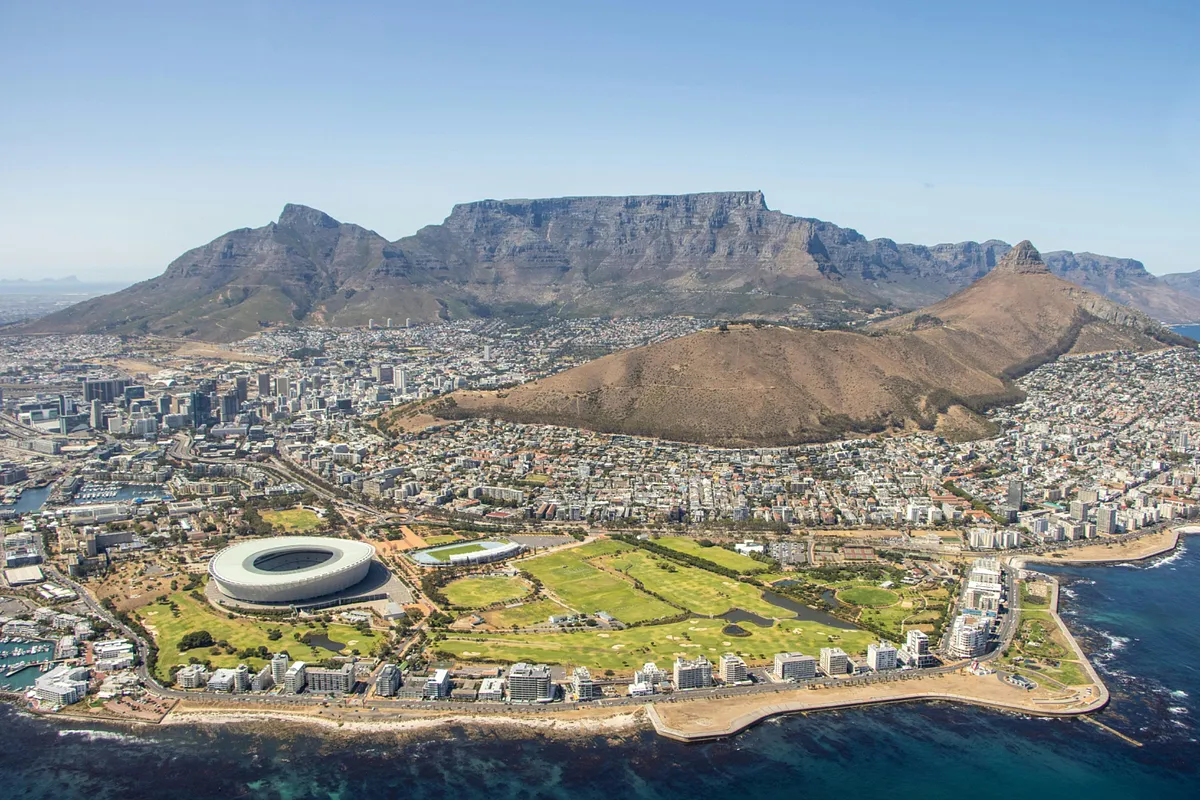
Table Mountain rises directly behind the city bowl, and the Atlantic seaboard runs north through Green Point and Sea Point toward the clifftop suburbs at Camps Bay and Clifton, with the V&A Waterfront anchoring the working harbour between the mountain and the ocean. There is no bad base in Cape Town - but each area has a different character, a different price band, and a different relationship with safety after dark, which genuinely matters here.
My shorthand: Sea Point or Green Point for the best balance of safety, walkability and price; Camps Bay if you will pay a premium for the beach setting; the V&A Waterfront for city convenience over atmosphere. Whichever you pick, the city is a base for the bigger trip - Table Mountain, the Cape Peninsula, the Winelands and the Garden Route are all within reach.
Getting there
Cape Town International (CPT) is about 20km east of the city, and there is no rail link - an Uber, a pre-booked shuttle or a hire car is the way in, around 25-40 minutes depending on traffic and where you are staying. Uber is cheap, plentiful and the safe default here. For routes into South Africa by origin, see the South Africa country guide.
From within South Africa
Cape Town anchors the south - here is how it connects to the rest of the country.
| From | Method | Journey time | Notes |
|---|---|---|---|
| Johannesburg | Flight or drive | ~2h / ~14h | Always fly - the 1,400km drive is roughly London to Warsaw. FlySafair, Kulula and SAA run frequent cheap fares. |
| The Winelands | Drive | ~45min | Stellenbosch and Franschhoek are an easy day trip or overnight east of the city - a hire car or a wine tour. |
| The Garden Route | Drive | 4h+ | The coast road east toward Knysna and Plettenberg Bay - a multi-day self-drive, not a day trip. |
| Kruger | Flight (via Johannesburg) | ~half day | For safari, fly to Johannesburg and connect to Hoedspruit/Skukuza, or build a separate Kruger leg. |
Getting around
A hire car is the move if you plan to drive the Cape Peninsula, Cape Point or the Winelands - distances are real and public transport does not reach them. In the city itself, Uber is cheap, reliable and the safe choice, especially after dark; the MyCiTi bus covers the Atlantic seaboard and the Waterfront efficiently. Walking is fine by day in Sea Point, Green Point, the V&A and the Camps Bay strip; after dark, take an Uber rather than walking, and apply normal South African city awareness in the CBD and the lower end of Long Street.
What to see
The headline sights, in the city and within a day of it.
Table Mountain
The flat-topped icon above the city - the cable car up (weather permitting) or the Platteklip Gorge hike. Go on a clear, still morning before the cloud "tablecloth" rolls in.
The V&A Waterfront & Robben Island
The harbour district for shops, restaurants and the ferry to Robben Island, where Mandela was imprisoned - book the island tour well ahead, it sells out.
The Cape Peninsula & Cape Point
The all-day drive south past Chapman's Peak, the Boulders Beach penguins and the Cape of Good Hope - one of the great coastal drives anywhere. A hire car or a tour.
The Winelands
Stellenbosch and Franschhoek, 45 minutes east - world-class wine, food and mountain scenery. The Franschhoek wine tram is the no-driving way to do it.
Bo-Kaap & the city bowl
The painted Malay-heritage houses on the slopes of Signal Hill, the Company's Garden, and Kloof Street's cafes - the cultural and culinary heart of the centre.
Neighbourhoods & hotels
Where you stay in Cape Town matters more than in most cities. Pick a neighbourhood for detail and hotel picks.
The Atlantic seaboard north of the city bowl, linked by a long, well-lit promenade - the mountain behind, the ocean in front, and among the safest parts of the city after dark. Sea Point has the better restaurants at better value than the Waterfront; Green Point is closer to the V&A and the stadium. My pick for the best balance of safety, walkability and price.
On the Atlantic side of the Twelve Apostles - a wide beach strip, ocean-facing restaurants and one of the most photographed settings in South Africa, with hotel pricing to match. Clifton just south has quieter beaches and more self-catering. The trade-off is convenience: 15-20 minutes from the Waterfront by car, and not walkable to the rest of the city.
The working harbour turned tourist zone - the ferry to Robben Island, the shops and restaurants, and a big share of the city's hotel stock. Efficient, safe and well-maintained, if a little lacking in character the way high-end harbour developments tend to be. The pick if you want everything within easy reach.
At the foot of Table Mountain, between the cable-car station and Long Street - Kloof Street's cafes, the Company's Garden and the museums. The most residential of the central areas, with fewer but better-value boutique hotels. Fine by day and manageable in the evening around Kloof and Gardens; Uber rather than walk the lower CBD after dark.
De Waterkant's pastel terraced houses, built up by Cape Town's LGBTQ+ community, sit between the Waterfront and the City Bowl - mostly self-catering apartments and a few guesthouses, one of the city's most Airbnb-heavy postcodes. Bo-Kaap on the Signal Hill slopes above adds the painted Malay-heritage houses and cobbled streets, a ten-minute walk down to the centre.
Worth the trip
The trips worth booking out of Cape Town.
Cape Peninsula and Cape of Good Hope
The full peninsula loop - Chapman's Peak, the Cape of Good Hope, and the penguins at Boulders Beach. The single best day out of the city, and the coast road is the star.
Check availability →Table Mountain cable car
The rotating cable car to the flat summit for the view back over the city bowl and the Atlantic. Go on a clear, wind-free morning - the cableway closes when the cloud comes in.
Check availability →Robben Island
The ferry from the V&A Waterfront to the prison island where Mandela was held, with former political prisoners as guides. Book ahead - sailings sell out and rough seas cancel them.
Check availability →Cape Winelands
Stellenbosch and Franschhoek an hour inland - Cape Dutch estates, world-class reds, and a long lunch. Take the tour so nobody has to drive.
Check availability →Good to know
Safety after dark
Cape Town needs real awareness at night - Uber rather than walk, stick to well-lit, busy areas (Sea Point promenade, V&A, Camps Bay strip), and apply normal South African city caution in the CBD and lower Long Street.
Getting in from CPT
No train - Uber, a pre-booked shuttle or a hire car, around 25-40 minutes. Uber is cheap and the safe default for the airport run.
Hire a car for the Peninsula
You do not need a car in the city (Uber covers it), but you do for the Cape Point drive, Chapman's Peak and the Winelands - public transport does not reach them.
Load-shedding
Scheduled power cuts still happen - most good hotels have backup generators, but check, and keep a power bank and the EskomSePush app for the schedule.
Sun & the tablecloth
The Cape sun is fierce - factor 50 and a hat. For Table Mountain, go early on a clear, still day before cloud closes the cable car.
Tipping
10-15% in restaurants, and tip car guards (a few rand), petrol attendants and safari guides - cash, and it is genuinely expected here.