
The Eurail Pass sells you spontaneity insurance. That's what it is. You're paying a premium for the freedom to hop on any train, anytime, without booking ahead. Sounds good. The problem? Most people plan more than they want to admit.
I've watched travellers spend €415 on a 15-day pass, then stick rigidly to the same itinerary they could've booked two months in advance for €250. They paid more for flexibility they never used. That's the trap.
The pass isn't the no-brainer it was in 2015. Point-to-point tickets got cheaper. Budget carriers compressed prices. Advance purchase discounts improved. People are still using 2016 logic on 2026 prices, and the mathematics doesn't work the same way anymore.
But there's still a case for it. Sleeper trains. Rural routes where there's no budget competition. Last-minute bookings when plans change. The pass wins in specific situations, not all situations.
This article breaks down the actual costs, shows you where the pass beats individual tickets, and gives you a 20-minute method to decide. I'm doing the spreadsheet, not the romance.
Eurail Pass 101: what you're actually buying
A Eurail Pass gives you unlimited train travel across participating European countries. You pick a pass type, activate it, and ride trains without buying individual tickets. You still pay seat reservations on some routes, but the base fare is covered.
Two main types exist: Global Pass (covers 33 countries) or One Country Pass (covers one country's rail network). Within those, you choose Flex or Continuous.
Flex passes give you a set number of travel days within a validity period. A 7-day pass in 1 month means you can ride trains on any 7 days within that month. The other 23 days, the pass sits in your pocket. Continuous passes give you unlimited travel for the entire validity period: 15 consecutive days, 1 month, 2 months, whatever you buy.
A "travel day" runs midnight to midnight on the calendar. Not 24 hours from when you board. For a direct night train, only the departure day counts. But if you catch separate trains that straddle midnight, you've just used two travel days. This confuses people constantly.
Current pricing (April 2026): a 7-day Flex Global Pass starts at €286 in second class - Eurail's most-popular option. A 15-day Flex starts at €415. A one-month continuous pass starts at €522. First class adds roughly 30-40% on top. Youth (ages 12-27) get up to 25% off; seniors (60+) get 10%. Prices shift through the year as Eurail runs promotions, so check eurail.com before you buy.
The two rules that burn people
Since 2020, Eurail is mobile-only for new passes. You must activate the pass in the Rail Planner app, then create a journey for every train before you board. No activation and no journey on the app means no valid pass - the conductor sells you a full-price ticket on the spot. I've seen this happen. It's not a warning, it's a full fare.
The midnight cutoff causes arguments at stations. People take two separate trains - say, a regional connection at 10pm into a sleeper at 1am - and think they've used one travel day. Wrong. They've used two. Conductors don't care about your interpretation. The rule counts each journey's start date on the calendar, end of discussion.
Plan overnight journeys carefully. On a direct night train, only the departure day counts - the arrival morning doesn't touch your pass. But the moment you change trains after midnight, you've burned two days. Check the Rail Planner app when you create the journey; it tells you exactly which days will get used.
These aren't edge cases. They're common mistakes that cost people money and cause stress. Activate your mobile pass before your first train, and understand the midnight rule before you plan your first route.
2026 costs: pass price + hidden fees
The pass price is just the start. Seat reservations add €0-€45 per journey, depending on the route. High-speed and international trains almost always require them. Regional trains usually don't.
Eurostar (London to Paris, Brussels, Amsterdam) costs €35-€43 per reservation, depending on class. The Glacier Express in Switzerland is CHF 54 (about €55), flat year-round. France's TGV network charges €10-€35. Italy's Frecce trains want €10-€13. Spain's AVE trains cost about €10.
Some routes are free on daytime services. Vienna to Berlin on Railjet or ICE, Berlin to Amsterdam on ICE International, most regional trains in Germany and Austria - no reservation needed, you sit in any available seat. Nightjet sleeper services on the same routes do require a reservation, typically €25-€50 depending on the berth.
For a typical two-week itinerary with 7-10 train journeys, budget €100-€200 for reservations. If you're riding Eurostar, Glacier Express, or multiple TGVs, budget €200-€380. This isn't optional spending. These trains won't let you board without a reservation.
The full picture for a 7-day Flex Global Pass:
- Pass cost: from €286 (second class, adult)
- Reservation fees: €100-€200 (conservative estimate)
- Total outlay: from €386
That's your real cost. Compare that number to point-to-point tickets, not just the pass price.
First class adds 30-40% to the pass price. You get bigger seats, quieter carriages, sometimes free coffee. Whether that's worth €100+ depends on how much you value space. I don't buy first class. Second class works fine for journeys under four hours.
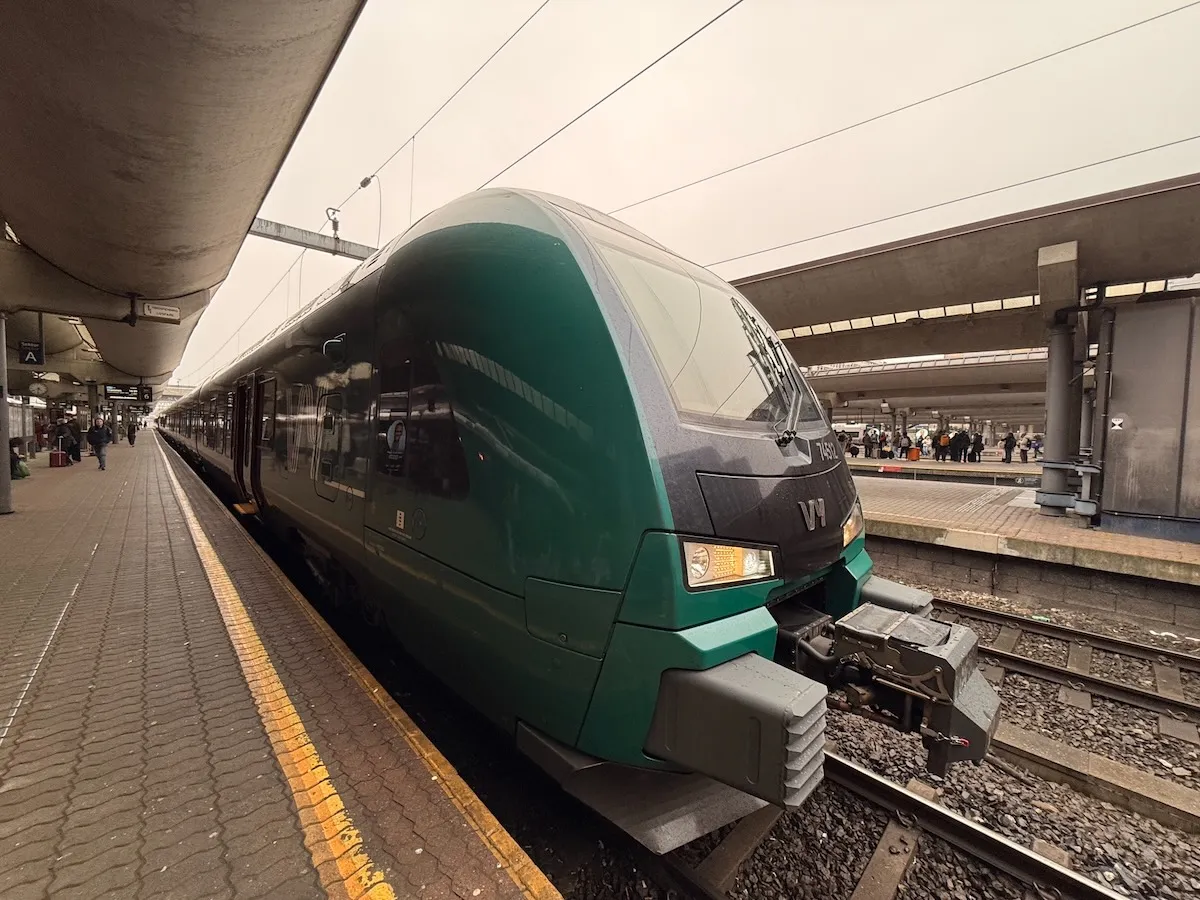
Vy Train locomotive at Oslo Gardermoen Airport, Norway (© Patrick Hughes)
The break-even math: when the pass beats point-to-point
A 7-day pass at €286 plus €150 in reservations costs €436 total. Divide that by 7 journeys: €62 per journey. If your average point-to-point ticket costs more than €62, the pass saves money. If it costs less, you're overpaying.
The 15-day Flex at €415 plus €250 in reservations needs an average journey cost of about €44 across 15 travel days to break even. Sounds easy. It's not. Most advance-purchase tickets on popular routes cost €30-€60. You need expensive routes (long distances, last-minute bookings, or Switzerland) to hit that average.
Booking window changes everything. Point-to-point tickets bought two months ahead are cheap. Same tickets bought three days out cost triple.
Cost analysis · Paris-Rome TGV + Frecce combo
Example: Paris to Rome on a TGV and Frecce combo. Two months ahead: €79. Ten days ahead: €139. Three days ahead: €189. The pass (with €13 reservation) costs €13 if you've already bought it. That's where the value appears - when you're booking late or staying flexible.
If you're booking everything in advance, the pass rarely wins. A sample itinerary with 7 trains across France, Germany, and Austria costs about €250-€300 if you book 8 weeks ahead. The pass costs €436. You've paid roughly €140 for flexibility you didn't use.
But book those same trains 10 days out, and the total jumps to €480-€550. Now the pass saves money. Book 3 days out, and you're looking at €650+. The pass wins clearly.
Where the pass actually saves money
Illustrative: a 19-journey itinerary across Europe (London, Paris, Amsterdam, Berlin, Prague, Vienna, Venice, Rome, Barcelona) can cost €2,600+ in point-to-point tickets booked last-minute. The same itinerary with a 15-day Flex Global Pass and reservations runs closer to €1,000-€1,200. That's roughly 55% cheaper in the worst-case last-minute scenario. Savings shrink hard if you're booking weeks ahead.
Specific routes where the pass saves money:
- London to Paris: €47-€86 saved (Eurostar advance tickets cost €77-€124; pass reservation is €38)
- Paris to Rome: €59-€80 saved
- Vienna to Berlin: €50-€140 saved (no reservation needed)
- Zermatt to St Moritz (Glacier Express): around €100+ saved on a single journey (CHF 54 reservation with a pass vs full fare)
Those savings assume you're comparing to standard-price or last-minute tickets. If you're comparing to advance-purchase tickets bought 8-12 weeks ahead, the savings shrink or disappear.
When a Eurail Pass is worth it
Night trains
The pass covers sleeper and couchette trains with just a reservation fee (€25-€50). Try booking a Paris to Rome sleeper last-minute without a pass. You'll pay €150-€250 for a couchette, €300+ for a private cabin. With the pass, you pay €29 for the reservation. That's the real arbitrage.
Rural routes in Scotland, Norway, or the Balkans
These networks don't have budget competition. Point-to-point tickets stay expensive. The pass destroys individual ticket prices on routes like Inverness to Kyle of Lochalsh, Oslo to Bergen, or Ljubljana to Lake Bled.
Switzerland
The country is expensive. A Zurich to Zermatt ticket costs €60-€80. Zermatt to St Moritz on the Glacier Express is €150+ without a pass; with one, you pay only the CHF 54 (~€55) reservation. If you're doing 4-5 Swiss journeys, the pass pays for itself.
Last-minute travel
If you're booking trains 3-10 days before departure, the pass almost always wins. Flexible tickets on high-speed routes cost €100-€200. The pass (already purchased) costs €0 plus reservation.
Youth travellers (under 28)
The youth discount brings a 7-day pass down to about €215 (25% off €286). At that price, plus reservations, the break-even threshold drops to roughly €52 per journey. Much easier to hit.
When it's not worth it - and what to do instead
Over 28, planning ahead, sticking to one region. If you're spending two weeks in Italy and you can book trains 6-8 weeks in advance, individual tickets often run €150-€250 total for 7 journeys. Point-to-point wins if you're confident in your schedule; a One Country Pass only starts paying off once you're taking enough journeys or booking close to departure.
Short itineraries with 3-5 trains. The pass doesn't make sense for a long weekend in Paris and Amsterdam. Two Eurostar tickets booked in advance cost €80-€120 total. The cheapest Global Pass is €212 for 4 days in 1 month, plus reservations. You're overpaying by €130+.
Mixing budget flights and trains. If you're flying Ryanair from Barcelona to Rome (€30) and only taking trains for short hops, skip the pass. Buy individual regional tickets as you go. They're cheap (€10-€25) and don't require advance booking.
What to do instead: for the lowest fares, book directly through the national rail websites - SNCF (France), DB (Germany), Trenitalia (Italy), ÖBB (Austria). Prices are lower than third-party aggregators and you'll see the full range of advance-purchase discounts. If juggling four operator websites sounds painful, Omio bundles it all into one English-language checkout - you'll pay a small premium for the convenience.
For budget options, check FlixTrain (Germany), Ouigo (France and Spain), and Italo (Italy). These are low-cost train operators that don't accept Eurail passes but offer tickets for €10-€40 on popular routes.
The "buy the spreadsheet" method: decide in 20 minutes
List every train journey you plan to take. Include departure city, arrival city, and approximate date. Be realistic. If you're "probably" doing a day trip to Bruges, include it. If it's a "maybe," leave it out.
Get point-to-point quotes from national rail operators. Use DB Bahn for Germany and most of Central Europe. Use SNCF for France. Use Trenitalia for Italy. Use ÖBB for Austria. Check prices for three booking windows: 8 weeks ahead, 2 weeks ahead, 3 days ahead.
Add seat reservation costs for each journey. High-speed and international trains need reservations. Regional trains don't. If you're unsure, assume €10-€20 for high-speed routes, €0 for regional.
Add up the total for all journeys. Compare that to the pass cost plus expected reservation fees. If the pass is cheaper by €50+, buy it. If it's within €50, ask yourself: do I actually need flexibility? Will I use all the travel days?
Factor in how you travel. If you're the type who books everything in advance and sticks to the plan, the pass probably isn't worth it. If you change plans, add spontaneous day trips, or book late, the pass makes more sense.
Run the numbers for both Global and One Country passes if you're staying in 1-2 countries. One Country passes start low (Italy from €124, France from €65, Spain and Sweden from €145 for their entry-level 3-day options) and often undercut a Global Pass if you're only riding that one country's network.
Where to price-check and buy
For most readers, the easiest place to buy is Eurail.com directly: English-language booking at the official pass price. Eurail.com also runs flash sales a few times a year (usually spring and autumn) with 10-20% discounts. Sign up for their email list if you're planning ahead.
For point-to-point price checks, use national operators first: bahn.com (Germany), sncf-connect.com (France), trenitalia.com (Italy), oebb.at (Austria). These show the cheapest advance-purchase fares.
Aggregators like Trainline and Omio are useful for quick comparisons - especially Omio when you want to see train, bus, and flight side by side on the same screen. They sometimes add booking fees or miss the cheapest fare classes, so use them for rough estimates, then book direct where it saves you money.
The questions that come up every time a Eurail thread hits a travel subreddit. Short answers, no filler.